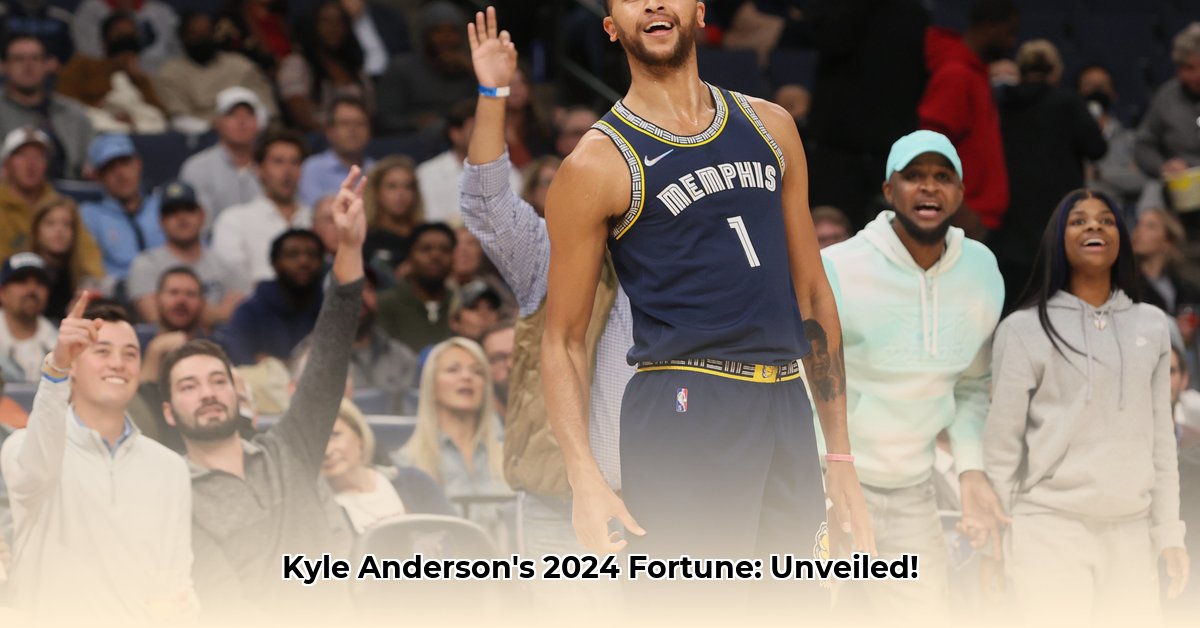
Understanding Kyle Anderson's Financial Landscape
Kyle Anderson's net worth in 2024 is not simply a straightforward calculation of his current salary. It's a complex equation influenced by his NBA contract, endorsement deals, potential future earnings, and undisclosed investments. While estimates place his net worth around $10 million, this figure represents an approximation rather than a precise value. This article will dissect the various components contributing to this estimation, highlighting both certainties and uncertainties.
Deconstructing Anderson's NBA Contract: A Three-Year Perspective
Kyle Anderson's three-year, $27.66 million contract with the Minnesota Timberwolves showcases a strategic blend of guaranteed and non-guaranteed compensation. The first two years are fully guaranteed, providing immediate financial security. However, the final year, at $8.78 million, presents a critical variable. This non-guaranteed component introduces significant risk and reward. High performance could lead to the Timberwolves exercising the option, substantially increasing his earnings. Conversely, decreased performance could result in the option being declined. This element of uncertainty impacts any precise net worth calculation.
How much does such a contract impact his overall financial standing? It's a significant portion, but not the complete picture. Let's explore further.
Beyond the Court: Endorsements and Investments
While Anderson's NBA salary forms the bedrock of his wealth, endorsements and potential undisclosed investments play a crucial role. Publicly known endorsements with brands like Essentia, PetCo, and Body Armor contribute to his income. However, the exact figures for these deals remain private. Moreover, he likely has additional investments—potentially in real estate or other ventures—that are not publicly disclosed. These unseen assets could significantly alter his total net worth. This highlights the inherent limitations in accurately estimating a celebrity's overall financial picture.
What other factors need to be considered to create a more complete picture? Let's examine further.
The Strategic Use of Bird Rights
Anderson's contract skillfully leverages Bird Rights, special NBA rules that allow a team to exceed the salary cap to re-sign its own players. This strategic clause ensured Anderson received a more lucrative deal than he might have in unrestricted free agency. It underscores the importance of skilled negotiators and strategic planning in maximizing an athlete's earning potential. The utilization of Bird Rights benefited both Anderson and the Timberwolves by securing talent but managing financial risk.
What impact do these rights have? What are the considerations? Let's dive into these aspects.
Projecting Future Earnings: A Multifaceted Prediction
Predicting Anderson's future net worth is inherently speculative, contingent on numerous factors. His on-court performance will significantly influence his earning potential, especially concerning the non-guaranteed portion of his current contract. The team's success and his role in that success are equally influential in future negotiation leverage. New endorsement deals, the performance of any undisclosed investments, and even his health are all key factors. The dynamic nature of the NBA salary cap and player values further complicates any firm prediction.
Have other athletes used this successful strategy? Are there case studies we can learn from? The following section explores this further.
Case Study: How to Negotiate an NBA Contract Using Bird Rights
Kyle Anderson's contract serves as a real-world example of leveraging Bird Rights. Understanding the nuances of full, early, and non-Bird rights is pivotal in successful NBA contract negotiations. For teams, effective negotiation involves strategic long-term roster planning, accurate salary cap forecasting, and risk management. For players, it means understanding their Bird Rights eligibility, assessing their market value, and securing effective representation. The NBA's Collective Bargaining Agreement (CBA) is paramount in this process.
Key Takeaways:
- Bird Rights provide teams the flexibility to retain superior players.
- Understanding the various levels of Bird Rights is fundamental in negotiations.
- Both teams and players must manage risk and opportunities effectively.
- The Collective Bargaining Agreement establishes the framework.
Conclusion: An Ongoing Narrative
Estimating Kyle Anderson's net worth at approximately $10 million offers a reasonable approximation, but it's critical to acknowledge the inherent uncertainties. The non-guaranteed portion of his contract, undisclosed investments, the unpredictable nature of professional sports, and the ever-shifting NBA landscape contribute to a fluid calculation. His financial trajectory is a dynamic narrative, impacted by both his on-court performance and his off-court financial decisions. His story continues to evolve.